Individual Reflections
Nguyen Thi My Trinh

Although I completed my practicum for the MA TESOL program at the Naval Academy in Nha Trang, Khanh Hoa in April, the memories of that journey still remain vivid in my mind. As I sit here writing this reflection and looking back at the photos taken during those days, I can still feel the emotions that I experienced at that time.
Stress, pressure, relief, excitement, and even a little regret — these are the emotions that can define my experience. To me, the practicum was not simply a compulsory course in the program, it became a meaningful professional and personal journey that allowed me to re-evaluate myself as both a teacher and a learner.

At the beginning of the MA TESOL course, all students were informed that we would participate in a practicum as one of the compulsory components of the program. At first, my classmates and I felt excited and curious about the experience. We looked forward to the opportunity to work in a new educational environment and apply the knowledge we had gained throughout the course. When the practicum officially began, four other students and I were placed in the same group, responsible for a workshop and a micro-teaching session. I was chosen as the group leader.

Our first task was to decide on suitable topics for both the workshop and prepare a lesson plan for the micro-teaching session. Fortunately, the previous courses in the MA TESOL program had provided me with valuable academic knowledge and practical skills. They helped me better understand how to conduct educational research, collect and analyze data, and organize academic ideas in a systematic way. I realized that the knowledge gained from those courses was not merely theoretical but truly useful in real professional contexts.

During the practicum, I developed many important professional skills. As the group leader, I learned how to manage tasks more effectively, organize meetings, make decisions, and encourage my teammates throughout the preparation process.
I also improved my communication skills through constant collaboration and discussion with my group members. More importantly, I learned how to listen to different opinions, negotiate when disagreements occurred, and maintain a positive working atmosphere within the team.
In addition, the practicum strengthened my planning and organizational skills. We had to carefully prepare lesson plans, workshop materials, presentation slides, and even activities outside the academic sessions. Every stage required teamwork, responsibility, and careful preparation. I became more aware of how teaching strategies, classroom management, and lesson pacing could affect learners’ engagement and understanding.


Looking back on the entire practicum process, I realize that I experienced significant changes in both my behavior and my perception of teaching and professional development.
First, I learned that careful preparation is one of the most important factors leading to success. Our workshop received positive feedback from both lecturers and students from USSH as well as officers and teachers from the Naval Academy. I believe this success did not come naturally. It was the result of many weeks of teamwork, discussion, editing, practicing, and supporting one another. We transformed a simple topic title into a complete academic workshop through collective effort and commitment. That experience reminded me that successful teaching and presenting are always built on serious preparation behind the scenes.
Second, the micro-teaching session taught me an important lesson about leadership and responsibility. Although I have had more than 13 years of teaching experience at high school, I realized that experience alone does not guarantee perfect performance. During the micro-teaching session, some parts did not go as smoothly as we had expected because we had not practiced thoroughly enough beforehand. As the group leader, I felt that I had not fully completed my responsibility in ensuring that every member was adequately prepared. From that experience, I learned that no matter how experienced a teacher may be, careful rehearsal and detailed preparation before teaching are always essential.
Third, the practicum changed my perspective on collaboration. I used to believe that teamwork mainly involved dividing tasks among members. However, throughout this journey, I realized that effective teamwork also requires trust, patience, emotional support, and shared responsibility. Fortunately, my group members were cooperative, responsible, and supportive. We worked together not only as classmates but also as teammates who shared the same pressure, goals, and determination.

In conclusion, the practicum at Naval Academy was not only an academic requirement but also a valuable and unforgettable experience in my life. It allowed me to strengthen my professional skills, deepen my pedagogical understanding, and reconsider my attitudes toward teaching, leadership, and collaboration. I would like to sincerely thank USSH and Naval Academy for giving me and my classmates the opportunity to work and learn in such a disciplined, professional, and meaningful environment. I believe that the lessons and memories gained from this practicum will continue to influence and inspire my future teaching career.
Phan Thi Thu Thuy

CHANGE IN BEHAVIOR AND PERCEPTION
After completing the practicum, I experienced several positive changes in both my behavior and perception. Before the practicum, I believed that careful lesson preparation alone was enough to ensure a successful lesson. However, through real classroom experience, I realized that teaching requires not only preparation but also flexibility, quick decision-making, and the ability to respond effectively to unexpected situations. Another change in my perception is that I used to try to engage students with many activities, especially online quizzes. Now, I realize that I should balance game-based activities with other teaching activities in order to create a more effective classroom environment.
In addition, both the micro-teaching sessions and workshop activities significantly improved my teamwork skills and changed my understanding of what effective teamwork truly means. Throughout the MA program, I had participated in many group projects, and I previously thought teamwork mainly involved dividing tasks among members to complete assignments efficiently. However, this practicum helped me realize that real teamwork goes far beyond task distribution. Besides completing assigned responsibilities, we also needed to support one another emotionally, encourage each other under pressure, and create a positive atmosphere so that everyone could perform at their best. Since every member’s performance directly influenced the overall outcome, the whole team needed to work as one unified body toward a common goal.
Each member viewed the others as brothers and sisters in a family. Besides stressful meetings, we often had milk tea together and chatted to better understand one another. After the trip, I realized that I had gained not only more colleagues but also a close-knit family. Additionally, I learned a lot from my group mates, especially my leader, Mrs. My Trinh, who has rich experience teaching at a high school. She gave me useful advice on the importance of time management, and I also learned from the way she patiently delivered lessons despite the shortage of time.
PROFESSIONAL SKILLS I HAVE LEARNT FROM THE PRACTICUM
Through the practicum, especially micro-teaching sessions and workshop activities, I developed several important professional skills in English language teaching.
Firstly, I improved my time management skills. During demo teaching sessions at university, most students were our classmates who are also ESL teachers, therefore, they could easily follow instructions and participate actively in classroom activities. In those situations, exceeding the planned time mainly influenced assessment results. However, in real classrooms, time management became crucial as it directly influenced lesson flow and sometimes required teachers to stop activities early due to fixed timetables. This helped me learn to manage time more carefully and adjust activities flexibly.

Secondly, I also strengthened my lesson planning skills. In the military context, where internet access and technology were limited, I learned not to rely heavily on digital tools. Instead, I adapted lessons using simple teaching aids, body language, board work, countdown techniques, and interaction to keep students engaged.
Finally, workshop activities helped me develop teamwork and research skills. Our group worked for several months on a Project-Based Learning study, applying knowledge from Research Method 1 and 2 courses. Feedback from lecturers also helped me understand how to organize a workshop more professionally. Compared to a previous simulated workshop, this practicum gave me real experience presenting to an authentic audience, which helped me better connect theory with actual teaching practice.

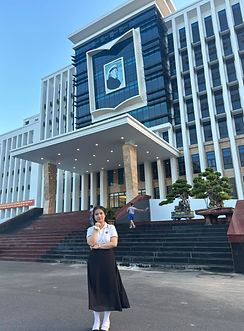


Bui Thi Thanh Tan


I entered this practicum with anxiety, exhaustion, and self-doubt. I left it with gratitude, clarity, and renewed confidence. My five-day practicum at the Naval Academy was not simply a course requirement in my MA TESOL program; it became a deeply personal experience and professional turning point that reshaped how I see teaching, teamwork, and myself. Until now, nearly a month later, I still find myself revisiting the photos, the classrooms, the faces, and the moments that now feel strangely distant yet emotionally close. What remains strongest is not the tight schedule or heavy workload we completed, but the inner changes I went through during and after the trip in terms of my professional skills and, more importantly, my perception and behavior.
I remember the deadlines and sleepless nights before departure, rushing to finalize the workshop, lesson plans, and teaching materials immediately after arriving in Nha Trang. Stress dominated my thoughts. I even wished the trip would end quickly before it had begun. Yet, once I arrived and became immersed in the work, something shifted. Pressure turned into focus. Nervousness turned into responsibility. I began to live in the moment rather than fear the outcome. Visiting the training sailing ship Le Quy Don 286 was unexpectedly emotional and memorable. Listening to stories of long voyages at sea made me appreciate the discipline, sacrifice, and commitment behind the peace on land and the dedication required to protect it. I truly felt humbled and grateful.

PROFESSIONAL SKILLS I HAVE LEARNT FROM THE PRACTICUM
First, the workshop helped me improve my analytical and research skills. To deliver the workshop, we had to read extensively, synthesize literature, design interview and survey instruments, code themes, build a thematic network, and discuss findings in relation to existing research. This process significantly strengthened my ability to analyze data, synthesize related studies, and think critically, which are all skills essential for my future thesis and academic career. The positive feedback and thoughtful questions from the audience affirmed the value and hard work of my group and transformed my initial fear of research into a genuine interest.

Second, I also developed my lesson planning skills by observing a writing lesson taught to naval cadets, which was such an eye-opening experience. I noticed how the teacher’s clear instructions, careful scaffolding, ICQs, CCQs, and effective peer interaction supported students in moving confidently from speaking to writing. I applied these strategies in my micro-teaching session by designing scaffolded grammar activities from basic concepts to complex sentence transformations and organizing competitive teamwork tasks suitable for the cadets’ preferences. I understood that an effective lesson is not about creativity alone, but about the balance between structure and flexibility.

Last, my time management skills were significantly enhanced. One of the most profound lessons came from failure in managing time during micro-teaching. I mistakenly exceeded my allocated time, which created a chain reaction that affected my teammates and delayed the class schedule. Seeing the next class waiting outside the door made me realize how individual actions impact the entire team. This incident taught me that time management is not merely personal discipline but professional responsibility, especially when working in a team. Planning must include flexibility and respect for others’ roles.

CHANGE IN BEHAVIOR AND PERCEPTION
Initially, I began this practicum focusing on performance and grades. I worried about whether I could do things well enough. I compared myself to others. I was afraid of making mistakes. Gradually, my mindset changed. I started to shift my attention to people rather than tasks. I noticed my teammates’ stress, their effort to attend late meetings, and their willingness to support one another. I became more aware of how my actions affected the group, not only myself. The micro-teaching incident was a turning point. I became so absorbed in teaching that I lost track of time. When I realized that my delay reduced my teammates’ teaching time and caused the next class to wait outside, I felt deeply embarrassed and guilty. That moment stayed with me, even until now. I understood that being a good teacher is not only about delivering content well. It is about responsibility, awareness, and teamwork. I learned to think beyond my own part and consider the whole big picture. I realized that in teamwork, personal performance must never come at the expense of the group. Since then, I have become more conscious of managing time and coordinating with others.
Technical problems during the lesson, such as the sound system not working, also taught me flexibility. I had to improvise, use my phone timer, and adjust activities on the spot. Later, my supervisor pointed out that I could have handled it more creatively, for example, by asking the whole class to count down from 10 to 1, or by suddenly slapping the table and stopping at random moments without warning them beforehand, to heighten the sense of nervousness and surprise. This reflection itself became a valuable lesson: teaching is imperfect, dynamic and requires flexibility rather than rigid adherence to plans.
Furthermore, the workshop changed my perception of research. I used to consider it a burden and see research as stressful and abstract. Through this experience, I saw how research connects to real teachers and real learners. Hearing participants express interest in applying PBL to their institutions made me feel that our work paid off and had genuine value. I became more interested in research and more confident in my ability to do it.

Emotionally, this practicum healed something in me. I used to feel that I was not excellent enough, not confident enough, and not capable enough for this profession. I doubted my competence and often compared myself to others. Through each activity, each challenge, and each small success, I slowly rebuilt and gained back my confidence. I realized that everyone struggles, everyone learns, everyone grows through experience, and everyone learns from mistakes. Most importantly, I stopped questioning whether I belong to this profession because I began to feel that I do.
Toward the end of the trip, during the relaxing moments and the gala dinner, I felt a sense of regret that I had spent too much time worrying at the beginning. I had not allowed myself to enjoy the journey fully. I was too busy worrying. Now, when I look back, I appreciate those imperfect, emotional, and stressful moments because they made the experience authentic and memorable.
This practicum at the Naval Academy was not only an academic requirement but also a healing and transformative journey. I left the practicum more reflective, more responsible, and more confident. I improved my analytical thinking, lesson planning, time management, and technological skills. More deeply, I changed my understanding of teaching, teamwork, and self-belief. I now understand that professionalism is not defined by flawless performance but by responsibility, adaptability, and continuous reflection. The memories, lessons, and emotions from these five days will remain with me as I continue my TESOL journey as a professional future educator.

This final part is dedicated to expressing my sincere gratitude to those who made this practicum trip far more meaningful and memorable than I could have imagined. I would like to express my heartfelt gratitude to Dr. Tran Thi Minh Phuong, my group’s supervisor, and Mrs. Ta Thi Thanh Tuyen, the lecturer of the class in which we delivered the micro-teaching at the Naval Academy, for their guidance, support, and encouragement throughout this practicum. My sincere thanks go to the EF and the Naval Academy for their harmonious cooperation in organizing this meaningful trip. I am also grateful to my 2024B classmates for their constant support, both physically and emotionally. Special appreciation goes to my 3B teammates: Ms. Trinh for her caring leadership, Ms. Thuy for her creative ideas, Ms. Thu for being our hairstylist, and Mr. Huy for capturing memorable photos. This journey brought us closer after nearly two years together and reminded me of the true value of companionship.

Ta Minh Thu

CHANGE IN BEHAVIOR AND PERCEPTION
The 2026 Practicum helped me become more aware of the importance of classroom management and bin teaching. I realized that teaching is not simply about following the lesson plan or textbook closely, but also adapting to unexpected situations and adjusting activities based on students’ responses and learning pace.
Through the class observation and microteaching session, I also learned the importance of paying attention to all learners equally. Instead of focusing mainly on active or high-performing students, I became more conscious of encouraging quieter students and monitoring each learner’s participation and interaction in class.
Overall, the internship helped me become more reflective, patient, and adaptable in teaching, while developing a stronger sense of responsibility toward creating a supportive classroom environment.

.jpg)
PROFESSIONAL SKILLS I HAVE LEARNT FROM THE PRACTICUM
- Communication skills: The Practicum Internship helped me improve my communication with learners, instructors and my teammates. I also became more confident when giving instructions, explaining activities, and interacting with students in class.
- Lesson planning skills: During the Practicum Internship, I was involved in lesson planning, preparing classroom activities, and organizing group tasks. These experiences improved my ability to manage time, prepare materials, and work more systematically.
- Presentation skills: Through both microteaching sessions and presenting during the English workshop, I developed greater confidence in public speaking situations and interacting with listeners naturally. I also learned how to manage presentation timing, explain ideas clearly and engage naturally with the audience.


Le Thach Nhat Huy

CHANGE IN BEHAVIOR AND PERCEPTION
Before the practicum, I viewed teaching primarily through a theoretical lens, but the hands-on experience at the Naval Academy has fundamentally shifted my perception of the profession. While I once believed a well-designed lesson plan was the sole key to success, I now realize that a teacher must be a flexible manager capable of reacting to real-time classroom challenges. Seeing the cadets’ enthusiasm despite occasional confusion taught me that a teacher’s primary role is to be a clear communicator and a facilitator of learning rather than just a lecturer.
This shift in perspective has made me much more detail-oriented regarding classroom management and instructional consistency. I now prioritize using uniform symbols for feedback, such as ✔ and ✖, and highlighting key grammar structures on slides to help students focus. Additionally, I have become more conscious of time management, learning to trim down activities to ensure every stage of the lesson is completed effectively without rushing.
In terms of my contribution to the group, I acted as the technical and analytical backbone for Group 3B. By handling the survey analysis for our STEM project and designing the visual aids for our teaching sessions, I ensured that our team presented a professional and data-driven image. My willingness to adapt materials based on supervisor feedback helped our group maintain high academic standards throughout the entire practicum journey.
PROFESSIONAL SKILLS I HAVE LEARNT FROM THE PRACTICUM
During my practicum at the Naval Academy, I refined my analytical and planning skills by bridging the gap between theory and practice. Through peer observations, I learned to manage lesson pacing more strictly and recognized that delivering clear, step-by-step instructions is vital for student comprehension. Beyond classroom management, I took an active role in technical planning, from designing engaging PowerPoint presentations and assessment questions to analyzing survey data for our group’s STEM workshop.
The military environment also enhanced my communication and cultural competency. I adapted my style to suit the academy’s disciplined atmosphere by using formal language and addressing the learners as "Cadets." I found that being concise and direct was essential to maintaining the flow of a 90-minute lesson. This experience taught me to navigate institutional expectations, successfully blending civilian teaching methodologies with the professional decorum and military discipline required in Nha Trang.
Finally, I developed stronger leadership and adaptability when faced with technical challenges, such as delivering lessons without internet access. I took the initiative to optimize offline tools and followed supervisor feedback by physically modeling tasks to ensure students remained aligned with the lesson goals. Leading by example in these situations allowed me to maintain high instructional standards, effectively preparing me for the complexities of a professional teaching career.


