MICRO-TEACHING
Acknowledgements: Students and Instructor

Firstly, we would like to express our sincere gratitude to Dr. Tran Thi Minh Phuong, our Practicum supervisor, for her continuous support throughout the internship. Having studied with her in previous courses, we truly appreciated her careful guidance and constructive feedback during the Practicum trip. Her comments on our lesson plans, teaching approaches, classroom management and ways of handling unexpected situations in class helped us gain a more practical understanding of pedagogy. Through her support, we also learned the importance of creating opportunities for every learner to participate eagerly and make the most of their strengths in the classroom.
Next, we would like to extend our sincere appreciation to both students and the instructors at the Naval Academy of Nha Trang for their support during our observation and microteaching sessions throughout our Practicum Internship 2026.
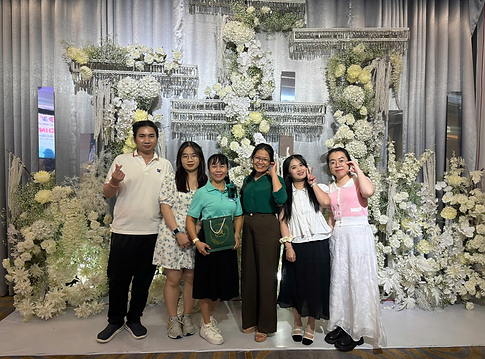
We are also sincerely grateful to the teacher, Mrs. Ta Thi Thanh Tuyen, for her thoughtful guidance and support throughout the internship. Her detailed feedback on our lesson plans, support for our group, and explanations about the class helped us better understand the learners and the teaching process. Overall, these experiences gave us valuable insights and helped us improve our teaching skills during the microteaching sessions.
To the classes KH41C, KRS26, and KT30 (2), despite being an elementary to lower-intermediate English level, the class showed impressive enthusiasm, quick responsiveness, and a strong willingness to communicate in English. The enthusiasm, quick responses and cooperative spirit shown through the lessons helped create a positive, lively and supportive learning environment. Thank you as well for the thoughtful class gifts, the snacks shared with the group, and the support in helping prepare and print the handouts before the lesson.

Class Observation Overview
.jpg)
-
Date & Time: Monday morning, April 13th (Periods 1–2, 7:00 AM–8:30 AM)
-
Location: Naval Academy
-
Supervising Teacher: Mrs. Vu Thi Kim Van
-
Classes Observed: BP17 and CSB18 (1)
-
Lesson Topic: Unit 5: A Place to Call Home from Close-Up B1
-
Language Focus: Writing an informal letter
-
Teaching Materials: Teacher’s handout and scaffolded classroom activities
-
Students’ English Level: A2–B1
From a general perspective, the students were attentive, obedient, responsive, and eager to participate in classroom activities, particularly during pair and group work. They also demonstrate a clear willingness to communicate despite limited linguistic proficiency. This indicates not only a strong foundation in basic English but also a positive learning mindset.
One particularly valuable observation was how the teacher scaffolded students carefully before the writing task. Instead of asking students to write immediately, the lesson gradually guided them through several preparatory activities, such as identifying the structure of an informal letter, organizing ideas, completing useful expressions, and discussing vocabulary related to describing a dream house. Group roles such as timekeeper, recorder, runner, team leader, and quality checker were also assigned to encourage collaboration and participation from different students.
In summary, the observation highlighted the importance of providing learners with sufficient language input and step-by-step support before asking them to produce written output. It also emphasized the teacher’s role in creating an engaging and supportive classroom environment where students feel encouraged to participate actively, communicate confidently and collaborate with their peers.
Microteaching Session:
Class Profile, Student Proficiency, and Instructional Materials
Our microteaching session was delivered to a class of fourth-year students at the Naval Academy of Nha Trang, with proficiency levels ranging from A2 to B1, and a class size of 20 students. The learners showed a positive learning attitude, actively cooperating and willingly engaging in communicative activities.

The lesson centered on the grammatical structures “Although/Despite” and “So/Such”, aiming to enhance students’ ability to express contrast and cause-effect relationships with greater accuracy. These target structures were introduced to facilitate the development of more complex sentence construction in both spoken and written communication.
Adapted from Close-Up B1 Student’s Book (Unit 12), the lesson was supplemented with visual materials and guided practice activities. A clear progression from presentation to controlled practice and communicative production was implemented to support students in gradually gaining confidence with the target structures.


Through this teaching session, students were encouraged not only to understand the grammatical forms but also to use them meaningfully in context. The overall goal was to enhance their grammatical accuracy while promoting greater fluency and confidence in real-life communication.

Reflecting on The Group’s Lessons:
Strengths and Areas for Improvement

The micro-teaching session at the Naval Academy provided us with a valuable opportunity to apply our pedagogical knowledge and skills in English teaching in a real classroom context. Overall, we felt encouraged by the students’ active participation and engagement throughout the lesson. Seeing cadets respond positively to our activities gave us a sense of confidence that our lesson was generally effective, meaningful, and appropriate for their level.
Strengths
One of the main strengths of our lesson was its clear and logical structure. Our group followed a sequence of Presentation, Practice, and Production stages to enable students to gradually build their understanding and confidently use the target language. In addition, we effectively applied Task-Based Language Teaching (TBLT) by designing meaningful and communicative tasks. The lesson incorporated a range of engaging activities, including Charades, Mini-board Race, and video watching, which reflected diverse teaching approaches such as the audio-visual teaching approach and gamification. These varied techniques helped maintain students’ interest and encouraged active participation throughout the lesson.
We also felt proud of our thorough preparation for the lesson. We used various teaching aids, such as the board, markers, and a soft toy for interactive games. These materials helped create an enjoyable and dynamic learning environment, especially without the use of technology. Despite the restriction on Wi-Fi and technology, we adapted by preparing a video with English subtitles in case of sound problems and designing interactive activities instead of relying on online platforms. This limitation encouraged us to be more creative and flexible in our approach, relying on clear instructions, well-prepared materials, and direct teacher-student interaction. Our use of Instruction Checking Questions (ICQs) and Concept Checking Questions (CCQs) helped ensure that students clearly understood both the tasks and the target language.
Areas for Improvement
However, the lesson also revealed areas for improvement. One major issue was time management, as some activities did not proceed as planned, which affected the overall flow of the lesson. In addition, we realized that we included too many items within certain exercises, which may have overloaded students and limited their ability to fully notice, understand, and accurately apply the target structure.
Another concern was the heavy reliance on group work, with insufficient opportunities for individual practice. In a grammar lesson, individual production is essential for checking each student’s understanding and accuracy; however, some learners may not have had adequate chances to independently practice the target form. In terms of slide designs, some key grammar points were not highlighted, which may reduce the effectiveness of the presentation stage.
Moreover, classroom management, especially during group work, was not always smooth, as there was some confusion when organizing students into teams. This led to a loss of instructional time and may have affected students’ engagement and focus on grammar tasks.
Feedback Session
After the micro-teaching session, our group had a chance to receive valuable feedback from our supervisors, Dr. Tran Thi Minh Phuong and Mrs. Ta Thi Thanh Tuyen. The feedback highlighted several practical issues across different stages of the lesson, along with clear directions for improvement.

Firstly, our classroom management was considered not sufficiently tight and consistent. Students were grouped quite confusingly when they were divided into different groups at different stages. Both teachers suggested that our group should fix the number and membership of teams throughout the whole lesson. There was also an inconsistency in how instructions were delivered, particularly when using tick–cross or true–false formats.
Secondly, we also received feedback on instructional techniques. For example, when teaching core grammar structures, slides should consistently highlight key structures. Moreover, we should also pay attention to reminding students of when to use punctuation in although/despite structures, as well as some special cases when changing adjectives into adverbs (e.g. late can function as both an adjective and an adverb, while lately means “recently”), and when to use a/an or no article in so/such structures.
The lesson wrap-up was also too limited, focusing only on although/despite instead of reviewing all target structures such as so/such. Additionally, some instructions were lengthy, especially when delivering grammar points and activity instructions, which affected students’ understanding and focus. Dr. Phuong also suggested that students should be asked to read sentences individually rather than chorally so that teachers can better check pronunciation.
Thirdly, time management at the individual level needs improvement. Some activities exceeded the planned time, which affected the overall flow of the lesson. We need to allocate time more carefully and be more flexible in adjusting activities to ensure all stages of the lesson are completed punctually. Flexibility in classroom management could also be improved.
For example, instead of using a bell as planned in the lesson plan, teachers can use the board for students to respond, since the board was already used in previous parts of the lesson; this helps save time and maintain continuity. In the “pass the parcels” activity, when facing difficulties with sound systems, teachers can create sound and engagement by using structured countdowns (e.g. 10–9–8), visual countdowns on slides or phones, or clapping to control timing more effectively.
Additionally, for some exercises such as the matching section, it was suggested to reduce the number of items and assign group representatives to write answers on the board instead of handling everything orally, in order to improve clarity and control.
Mrs. Tuyen expressed that student engagement and classroom interaction need to be improved. As the core knowledge focuses on grammar, students should have more opportunities to write individually through exercises, as too many activities, although engaging, may distract students when overused.

Dr. Phuong agreed and added that there were moments when not all students had equal opportunities to participate, and some students who raised their hands were not called on, while certain students were called on repeatedly. This highlighted that teachers should better observe the whole class and ensure more balanced participation.
